

Exhibition - Filming the War: the Soviets and the Holocaust
What were the commercial and industrial mechanisms behind the Soviet cinematographic creations from 1939 to 1949? What cultural and social processes explain their system of production, distribution and how they were perceived? To answer these questions, the CINESOV partners started by making an inventory of the productions (fictions and documentaries) of the Second World War and the immediate post-war period. This work provided the foundation for an analysis of the Soviet cinematographic policy and its economic and social implications. It emerges that social exclusion and heroisation strategies were organised, and that the Soviet Union had its own specific cinematographic approach to the Holocaust. A second focus of the CINESOV project consisted in analysing the way the cinema was used as a propaganda weapon with respect to both the Soviet public and the rest of the world. It is these two aspects that are explored by the exhibition "Filming the War - The Soviets and the Holocaust, 1941-1946".
Understanding the construction of a collective imagination…
From the very beginning of 1942, the Soviets started winning back lost territory: North-West Russia, the South-East tip of Ukraine. But in the summer of 1942, a powerful German offensive pushed the Nazi domination as far as the Caucasus. In 1943 - a turning point in the war - the Red Army regained the upper hand, freeing first the south of Russia, then Ukraine and Belorussia. The following year, it reached Poland while continuing its progress in the Baltic countries. The Soviets were therefore the first to discover the massacres of civilians and the mass executions committed by the Nazis (Kertch, Babi Yar). They were also the first to meet living witnesses and to enter the extermination camps (also known as death camps or killing centres), including Auschwitz. Dozens of film operators with cameras were present at the time. They thus filmed more varied images than those of the Allies, who did not have access to the killing centres and were not confronted with the diversity of the methods of murder used by the Nazis in Soviet territory.
These images – whether used to edit filmed news documentaries, medium or long feature films, or simply set aside in the film archives - are the main media used in the "Filming the War - The Soviets and the Holocaust" exhibition. These films remained forgotten for many years. Firstly because these archives raised suspicions - following the Katyn Massacre - of having served Russian propaganda and secondly on account of the Cold War, but also because the images did not find their place in a discourse on the unity of the Soviet people against the universality of Nazi savagery. During the war, the films did effectively play a role in a general propaganda effort aiming at inciting vengeance in the population and encouraging the Allies to open a new front in the East. As from the end of 1942 they were also used to document an extraordinary commission of inquiry. The aim here was to reveal the violence of the Nazis, who destroyed the proof of their actions. The Soviet films adapted their tone to the purpose and the political context. The testimonials were thus intended to stimulate emotion, while the methodical description of the functioning of the death camps served to document the post-war crime trials. In the 1960's the images were again used in a context of efforts to construct a memory of the war combined with an intensification of the Cold War where it was a question of denouncing the protection that former war criminals were afforded in the West.
Thus, in 1941-1945, as in the 1960's, the Kremlin chose to minimise the anti-Semitic nature of the Nazi violence in order to present the enemies' crimes as a plan to exterminate all the peoples of the USSR and their culture.
And rehabilitating the work of the Soviet film operators
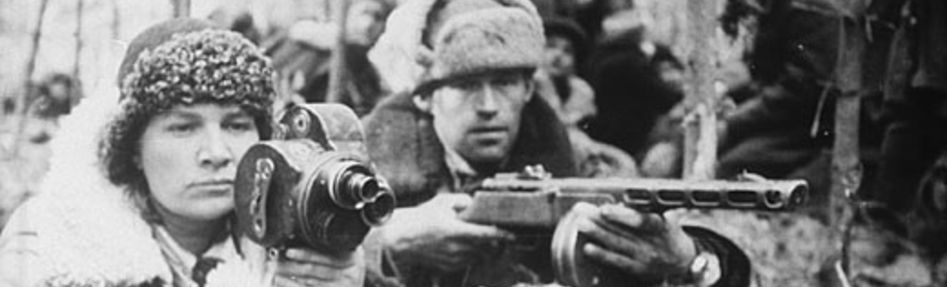
But if the exhibition provides a grasp of the methods of construction of the collective imagination made possible by these films, it also sets about dissecting the complexity of their creation and valorising the work of the Soviet and Polish film operators integrated in General Berling's division alongside the Red Army. By showing the war-time film production circuit and the very real difficulties encountered by the cinematographic teams on the battlefront, particularly the severe shortage of film supplies and audio and lighting equipment, the commissioners show that with the exception of the film falsifying the Katyn Massacre, the operators were constantly urged to deliver "true" images and ban staged set-ups. Although it is true that their films were sometimes politically oriented, the exhibition points out that the same was true of the American films and that the existence of examples such as Katyn does not call into question the authenticity of the main corpus of Soviet films of that period.
The CINESOV project
Coordinated by Valérie Pozner, a historian specialised in Soviet cinema and a member of ARIAS (Research Workshop on Intermediality and Performing Arts), CINESOV also involves ARCHE (Arts, Civilisation and History of Europe) and the CEFR (Franco-Russian Studies Centre) in Moscow. It is funded by ANR for a period of three years for a total of 235,560 euros.
Find out more:
- Shoah Memorial:
17, rue Geoffroy l’Asnier
75004 Paris
01 42 77 44 72
Pont Marie or Saint-Paul Metro
From Sunday to Friday, 10h00 to 18h00. Evening opening on Thursdays (22h00). Entrance free. - The CINESOV project presented on the ANR website
- The exhibition page on the Shoah Memorial website
Photo : © RGAKFD Maria Sukhova, film operator on the battlefield
