

Écosystèmes coralliens
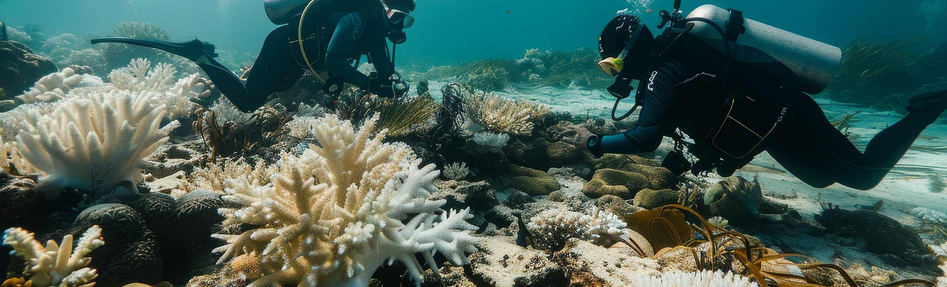
CORAL REEF research
Coral reefs are threatened by global warming, which, with an increase of only 1°C above normal summer temperatures, causes massive bleaching and increased coral mortality.39 ANR-supported projects have led to significant advances in the understanding and management of these ecosystems, particularly on the degradation of coral habitats; the impacts of El Niño on reef ecosystems; the development of genetic connectivity models for fish populations; and restoration techniques, such as larval rearing and coral micro-fragmentation. The projects have also highlighted the importance of genetic diversity and microbial communities for reef health, with the identification of strains resilient to warming waters. Research perspectives include the interdisciplinary integration of genomics, ecology, climate modeling, and social sciences, as well as international collaboration to strengthen coral research in degraded habitats.
Serge Planes: CNRS-EPHE-UPVD, Perpignan
1- Scientific background
The increase in global mean surface temperature (GMST), which reached 0.87°C in 2006–2015 relative to 1850–1900, has increased the frequency and magnitude of impacts, strengthening evidence of how an increase in GMST of 1.5°C or more could impact natural and human systems (1.5°C versus 2°C). Global warming (i.e., heat stress; Hoegh-Guldberg, 1999; Baker et al., 2008; Spalding and Brown, 2015; Hughes et al., 2017a) has emerged as the greatest threat to coral reefs, with temperatures of just 1°C above the long-term summer maximum for an area (reference period 1985–1993) over periods of 4–6 weeks being sufficient to cause mass coral bleaching (loss of the algal symbionts) and subsequent mortality. With the global warming observed to date, a large proportion of coral reefs have experienced large-scale mortalities that have led to a sharp reduction of coral populations. Predictions of consecutive bleaching events (Hoegh-Guldberg, 1999) became reality in the summers of 2016–2017 (e.g., Hughes et al., 2017a), as did projections of declining coral abundance. Therefore, a world with 1.5° to 2.0°C above pre-industrial levels will lead to major mortality of corals and disappearance of some coral reefs (Donner et al., 2005; Hoegh-Guldberg et al., 2014; Schleussner et al., 2016; van Hooidonk et al., 2016; Frieler et al., 2017; Hughes et al., 2017b).
In such a context of coral reef decline, coral reef science has rapidly evolved in the last decade, spurred by novel molecular techniques, advanced monitoring technologies, and innovative restoration strategies. These developments are critical for understanding and mitigating the impacts of climate change, ocean acidification, and local anthropogenic pressures on coral ecosystems. We can identify key areas that have shown change in paradigm linked to the declining context of coral reef.
Climate Change, Stressors, and Coral Resilience
Recent high-resolution studies confirm that rising sea temperatures and ocean acidification are primary drivers of coral bleaching and mortality. Satellite remote sensing, coupled with in situ measurements, now allows researchers to monitor thermal anomalies with unprecedented accuracy. For example, Hughes et al. (2018) documented that repeated bleaching events, even when severe, can sometimes be followed by partial recovery in resilient coral populations. Similarly, Guest et al. (2019) demonstrated that local environmental factors—such as hydrodynamics and shading—play crucial roles in modulating bleaching responses. Advances in molecular biology have deepened our understanding of coral stress responses. Genome-wide studies have revealed that some coral populations harbor genetic variants and epigenetic modifications that enhance their tolerance to heat (van Oppen et al., 2017; Bay et al., 2020). Metagenomic analyses show that corals can alter their symbiotic associations with dinoflagellates (Symbiodiniaceae) in response to stress. Studies by Rosado et al. (2019) and LaJeunesse et al. (2018) highlight that a shift toward thermotolerant symbiont clades correlates with enhanced resilience.
Technological Innovations and Enhanced Monitoring
Technological progress has revolutionized reef monitoring with the deployment of autonomous underwater vehicles, drones, and high-resolution satellites now enables continuous mapping of reef structure, water quality, and bleaching events (Donner et al., 2020; Mumby et al., 2020). Machine learning applied to these datasets improves prediction accuracy and informs adaptive management strategies. Distributed sensor networks measuring key environmental parameters (temperature, pH, salinity) allow for real-time monitoring. These systems have been pivotal in linking episodic stress events to coral responses, supporting adaptive management (Perry et al., 2019).
Advances in Coral Restoration Techniques
Restoration research has evolved from traditional coral gardening to sophisticated approaches that address both ecological and genetic dimensions. Techniques such as larval rearing and micro-fragmentation have shown promising results. Lirman et al. (2018) demonstrated that micro-fragmented corals can rapidly regenerate, significantly accelerating reef recovery. French research led by Mills and colleagues has further refined these techniques to maximize genetic diversity and resilience. Field experiments have tested the transfer of resilient coral genotypes to more vulnerable reefs. Assisted gene flow, as detailed by van Oppen et al. (2017) and supported by French investigations (e.g., Mills et al., 2019), shows promise in boosting the adaptive capacity of coral populations. Recent studies are exploring the manipulation of coral-associated microbial communities to enhance health and reduce bleaching. Work by Peixoto et al. (2021) and contributions from French scientists such as Sabourault et al. (2016) underscore the potential of “probiotic” treatments in improving coral resilience.
Integrative and Socio-Ecological Approaches
Recent coral reef studies increasingly integrate natural science with socio-economic perspectives. Recognizing that coral reefs provide critical ecosystem services—from coastal protection and food security to cultural heritage—researchers have begun incorporating social science methods to assess human dependencies on reef ecosystems. Anthony et al. (2019) and French experts like Lecchini et al. (2010) have illustrated how local management practices and traditional ecological knowledge enhance reef resilience. The coupling of high-resolution environmental data with socio-economic indicators has led to the development of decision-support tools. These tools are vital for designing adaptive management strategies that balance conservation with the livelihoods of coastal communities (Mumby et al., 2020; Perry et al., 2019). Contributions from French institutions such as the MSH-P and CRIOBE have been instrumental in this integrative approach.
The next phase of coral reef research focuses on multi-stressor experiments that integrate thermal, chemical, and biological challenges. Integrated models combining genomics, remote sensing, and socio-economic data are expected to yield more accurate predictions of reef trajectories under future climate scenarios (Fuller et al., 2020; Donner et al., 2020).
2 - Main contributions of the French communities through ANR co-funding
Overall, over that last decade coral reef science has moved beyond purely ecological descriptions to a systems-level understanding that includes genomics, environmental chemistry, modeling, and socio-economic analysis. Yet, knowledge gaps remain—particularly regarding multi-stressor impacts, transgenerational adaptation, and large-scale ecological tipping points. The projects funded by the French National Research Agency (ANR) collectively have addressed some of these gaps through cutting-edge research, cross-disciplinary collaborations, and innovative field and laboratory approaches.
In this section we focus on the ANR-(co)funded and PIA funded projects that illustrate France’s contributions to coral reef and marine biodiversity research. They have advanced our understanding of reef ecology, climate impacts, and socio-ecological dynamics, each featuring both scientific progress and innovation for stakeholders.
2.1 - Scientific Progress: Cutting-Edge Science
Recent French ANR-funded projects have collectively transformed our understanding of coral reef dynamics by integrating advanced field studies, innovative molecular techniques, and sophisticated modeling approaches. For instance, the Coral Reefs project (ANR-06-JCJC-0012), coordinated by David Lecchini at IRD, provided early and crucial insights into how habitat degradation—marked by a shift from coral-dominated to algal-dominated states—impacts the recruitment success of reef organisms such as fish, mollusks, and crustaceans. This project demonstrated that as coral cover declines, critical sensory cues used by larvae for habitat selection become altered, thereby reducing larval settlement and survival ( Lecchini et al, 2010; Dufour et al, 2010). Detailed laboratory and in situ experiments, including chemical and acoustic analyses, revealed that disrupted reef structures can compromise the complex behavioral and physiological processes that underpin successful recruitment, setting the stage for cascading effects on reef biodiversity.
Building on this foundation, the ELPASO project (ANR-10-BLAN-0608), under the coordination of Pascale Braconnot, advanced our understanding of large-scale climatic phenomena by reconstructing historical ENSO variability and linking these oscillations to shifts in marine productivity, thereby informing predictive models of reef ecosystem responses (Braconnot et al,2012). In parallel, the IM-MODEL@CORALFISH project (ANR-10-BLAN-1726) led by Serge Planes, developed novel maximum-likelihood models that capture the genetic connectivity and evolutionary history of reef fish populations, highlighting the importance of historical isolation and migration patterns in shaping contemporary reef biodiversity (Delrieu-Trotin et al, 2019).
Further exploring the resilience of reef ecosystems, the LIVE AND LET DIE project (ANR-11-JSV7-0012), coordinated by Suzanne Mills, provided critical insights into how multiple stressors—ranging from thermal anomalies to overfishing—alter reef community structures and drive adaptive physiological responses in coral reef organisms, emphasizing the role of early life-history stages in maintaining ecosystem function (Mills et al, 2019). Complementing these ecological and genetic approaches, the inSIDE project (ANR-12-JSV7-0009), coordinated by Cécile Sabourault, delved into the molecular interplay between cnidarians and their dinoflagellate symbionts, unveiling key proteins and metabolic mediators that govern symbiotic stability and the onset of bleaching, thereby offering potential targets for future intervention strategies (Sabourault et al, 2016).
Meanwhile, the BIOCARRA project (ANR-13-ISV7-0002), managed by Claude Payri, focused on the biodiversity and biogeography of coralline algae—essential architects of reef structure—by integrating molecular phylogenetics with advanced histological analyses to resolve longstanding taxonomic ambiguities and to map the distribution of these critical organisms across the Indo-Pacific (Payri et al, 2019). Recognizing the importance of larval dispersal in sustaining reef populations, the Stay or Go project (ANR-14-CE02-0005), coordinated by Suzanne Mills, examined the interplay between parental traits and environmental stressors, such as thermal anomalies and anthropogenic noise, and how they influence larval behavior and dispersal capacity. Research from Stay or Go showed that factors such as maternal size and the condition of parental habitats critically determine the swimming performance and subsequent recruitment success of larvae (Mills et al, 2018). The project’s innovative use of transgenerational experiments provided evidence that under stressful conditions, parental effects can induce phenotypic plasticity in offspring, which in turn affects their ability to navigate and settle in optimal reef habitats.
Addressing the imminent threat of ocean acidification, the CARiOCA project (ANR-15-CE02-0006) utilized natural CO₂ seeps as analogues to study coral acclimatization, demonstrating that certain coral species can undergo physiological adjustments that enable survival under chronically low pH conditions, thereby providing hope for reef persistence in a high-CO₂ future (Rodolfo−Metalpa et al, 2018). Expanding the scope to include planktonic symbioses, the IMPEKAB project (ANR-15-CE02-0011) applied multi-omics approaches to elucidate how photosymbiotic interactions in both plankton and benthic organisms respond to thermal stress, thus contributing to a more comprehensive understanding of reef ecosystem dynamics and nutrient cycling (Not et al, 2020). At the forefront of recent advances, the CORALGENE project (ANR-17-CE02-0020) represents a landmark initiative that has taken a holistic approach to decode the genomic complexity of the coral holobiont across the Pacific. Coordinated by Serge Planes and embedded within the Tara Pacific Consortium, CORALGENE has leveraged high-throughput sequencing technologies, transcriptomics, and metabolomics to provide a comprehensive census of the genetic and microbial diversity present within coral reefs (See the paper list as www.nature.com/collections/adgaiffggg). This project not only uncovered a vast array of cryptic biodiversity within the coral host, its symbiotic algae (zooxanthellae), and associated microorganisms but also established critical links between genomic variation and environmental adaptation. By sampling across more than 40 island systems and employing cutting-edge meta-barcoding and meta-transcriptomic analyses, CORALGENE has generated robust datasets that reveal how coral holobionts respond to environmental stressors, such as warming and acidification.
Collectively, these projects illustrate the remarkable progress achieved by French research teams through ANR funding. Their integrated efforts highlight the power of a multidisciplinary approach—combining ecological, genetic, and molecular analyses with advanced monitoring and modeling—to deliver groundbreaking insights into coral reef resilience, inform adaptive management strategies, and foster innovative restoration techniques that are essential for safeguarding the future of these vital ecosystems in an era of rapid global change.
2-2 - Innovation for Private Enterprises, for Science Policy, for the Citizen, contribution to human societies.
Coral reefs provide livelihoods, protect shorelines, and hold cultural significance for coastal communities worldwide. ANR-funded projects such as Coral Reefs and LIVE AND LET DIE have shown how reef health directly affects fish populations, tourism potential, and artisanal fisheries. By examining larval settlement and habitat quality, researchers have informed sustainable fishing regulations and ecotourism guidelines that safeguard both economic returns and cultural heritage. In addition, studies from CARiOCA and CORALGENE offer data on coral genotypes more tolerant to warming or acidification, thus guiding reef restoration and mariculture ventures. These findings enable coastal communities to adapt their resource management—shifting from exploitative uses to practices aligned with reef conservation.
Methodological Breakthrough
Projects like IM-MODEL@CORALFISH and CORALGENE pioneered the application of high-throughput sequencing and advanced population genetics models, providing novel insights into reef connectivity and evolutionary history. This integrative genomic and ecological approach supports private enterprises in biotechnology—such as breeding resilient coral strains—and informs science policy by pinpointing critical habitats for protection. Furthermore, through combined remote sensing, in situ sensor arrays, and omics-based analyses, initiatives like ELPASO and IMPEKAB deliver real-time or high-resolution data on environmental variables and ecosystem responses. These methodological innovations yield early-warning systems for coral bleaching events, enabling policymakers to enact timely conservation measures and coastal communities to anticipate changes in fisheries or tourism.
Together, these ten ANR-(co)funded projects underscore the high-level scientific expertise of French research teams in coral reef ecology, molecular biology, climate science, and socio-ecological studies. Through cutting-edge science and innovations that benefit private enterprises, policy-making, and citizens, they collectively address the urgent challenges facing coral reefs. Their methodological breakthroughs—from advanced genomic modeling to integrative sensor networks—provide scalable solutions for coastal communities, informing both local and global strategies for reef conservation and sustainable development.
3 - Research Perspectives
Regarding scientific aspects, collectively, the portfolio of projects points to several key research frontiers. Future studies will increasingly address the combined impacts of warming, acidification, pollution, and overfishing through integrative experimental designs and field monitoring. We must undertake holistic methods that will capture the ecological complexity inherent in coral reef systems. Building on the success of transgenerational experiments, researchers are now exploring epigenetic and microbiome contributions to coral and fish resilience. Refined connectivity and demographic models will be integrated into ecosystem-based management frameworks and may merge with climate forecasting tools. In addition, deeper collaboration with social sciences will help evaluate the human dimensions of reef management, including governance structures, traditional ecological knowledge, and socio-economic trade-offs.
In terms of Innovation, ongoing improvements in autonomous sensors for temperature, pH, and acoustic pollution are leading to broader deployment, moving these technologies from pilot to operational status. Insights into coral–algae symbioses, and the genomic underpinnings of resilience could inspire new reef restoration materials such as thermotolerant coral strains, advanced settlement substrates, or probiotic treatments. Building upon connectivity modeling, the development of integrated reef management dashboards is on the horizon, incorporating real-time environmental data, genetic connectivity metrics, and socio-economic indicators.
Lastly, future perspectives should play a role in the structuration of the communities: National, European, and International Dimensions. Partnerships with institutions in the Pacific (including Papua New Guinea and Australia) and the Indian Ocean (notably Madagascar and La Réunion) facilitate trans-continental research on coral reef adaptation, reinforcing France’s leadership in tropical marine science and its ability to shape global reef conservation agendas. By coordinating resources, standardizing protocols, and pooling data, the French marine research community is well-positioned to expand collaborative projects that unite advanced scientific knowledge with practical management strategies and international policy frameworks.
Overall, this synthesis demonstrates how France’s ANR-funded coral reef and marine biodiversity projects collectively address pressing environmental challenges through pioneering research, innovative methodologies, and active stakeholder engagement. Together, these efforts build a robust foundation for future studies on reef resilience and for the sustainable management of coastal ecosystems worldwide.
Bibliography
- Anthony, K.R.N., et al. (2019). New interventions are needed to save coral reefs. Nature Ecology & Evolution, 3, 167–176.
- Bay, R.A., et al. (2020). Genomic signals of selection and adaptation to climate stress in coral populations. Molecular Ecology, 29, 1500–1514.
- Beldade, R., Mills, S. C., & Claudet, J. (2017). Cascading effects of thermally-induced anemone bleaching on associated anemonefish hormonal stress response and reproduction. Nature Communications, 8, 7165.
- Braconnot, P., Harrison, S. P., Kageyama, M., Bartlein, P. J., Masson-Delmotte, V., Abe-Ouchi, A., Otto-Bliesner, B., & Zhao, Y. (2012). Evaluation of climate models using palaeoclimatic data. Nature Climate Change, 2(6), 417–424.
- Braconnot, P., et al. (2015). Evaluation of CMIP5 paleo-simulations to improve climate projections. Nature Climate Change, 5, 735–743.
- Delrieu-Trottin E, Williams JT, Pitassy D, Driskell A, Hubert N, Viviani J, Cribb TH, Espiau B, Galzin R, Kulbicki M, Lison de Loma T, Meyer C, Mourier J, Mou-Tham G, Parravicini V, Plantard P, Sasal P, Siu G, Tolou N, Veuille M, Weigt L, Planes S, 2019. A DNA barcode reference library of French Polynesian shore fishes. Scientific Data 6. 595793
- Donner, S.D., et al. (2020). Predicting bleaching events on coral reefs using remote sensing and machine learning. Global Change Biology, 26, 2738–2751.
- Dufour, V., Riclet, E., & Lo-Yat, A. (2010). Extreme climatic events reduce ocean productivity and larval supply in a tropical reef ecosystem. Global Change Biology, 16(8), 2347–2355.
- Fuller, Z.L., et al. (2020). Population genetics of the coral reef snail Turbo castanea reveals recent colonization and rapid adaptation to warming oceans. Evolutionary Applications, 13, 290–303.
- Guest, J.R., et al. (2019). Coral resilience to bleaching: From observation to intervention. Trends in Ecology & Evolution, 34, 729–742.
- Hughes, T.P., et al. (2018). Global warming transforms coral reef assemblages. Nature, 556, 492–496.
- LaJeunesse, T.C., et al. (2018). Systematic revision of Symbiodiniaceae highlights the antiquity and diversity of coral endosymbionts. Current Biology, 28, 2570–2580.
- Lecchini, D., et al. (2010). Evidence of larval sensory cues in habitat selection and the role of reef degradation. Global Change Biology, 16, 2697–2706.
- Lecchini, D., Planes, S., & Galzin, R. (2010). Sound production and mechanism in Heniochus chrysostomus (Chaetodontidae). Journal of Experimental Biology, 213(12), 2102–2108.
- Lirman, D., et al. (2018). Rapid coral reef restoration using micro-fragmentation. Frontiers in Marine Science, 5, 234.
- Mills, S. C., Beldade, R., Claudet, J., & Lecchini, D. (2018). Transgenerational effects of thermal and noise stress on larval dispersal and recruitment in coral reef fishes. Marine Ecology Progress Series, 607, 229–241.
- Mills, S. C., Hedouin, L., Claudet, J., & Lecchini, D. (2019). Multi-stressor impacts on reef fish biodiversity and resilience in a changing environment. Coral Reefs, 38(4), 929–942.
- Norin, T., Mills, S. C., & Planes, S. (2018). Anemone bleaching increases the metabolic demands of symbiont anemonefish. Proceedings of the Royal Society B, 285, 20180282.
- Not, F., et al. (2020). Multi-omics insights into planktonic photosymbioses and thermal stress responses in coral reef ecosystems. The ISME Journal, 14(8), 1984–1996.
- Payri, C., De Reviers, B., Gabriel, D., & Verlaque, M. (2019). Revision of Corallinaceae (Corallinales, Rhodophyta): recognizing Dawsoniolithon gen. nov., Parvicellularium gen. nov., and Chamberlainoideae subfam. nov. Journal of Phycology, 55(5), 1252–1271.
- Peixoto, R.S., et al. (2021). Beneficial microorganisms for corals (BMC): Developing probiotics to enhance coral resilience. Trends in Microbiology, 29, 775–788.
- Planes, S., et al. (2014). Phylogeography and demographic history of coral reef fishes: The role of glacial cycles. Molecular Ecology, 23, 263–279.
- Rodolfo-Metalpa, R., et al. (2018). Suitability of the shallow-water hydrothermal system at Ambitle Island (Papua New Guinea) to study the effect of high pCO₂ on coral reefs. Marine Pollution Bulletin, 128, 119–128.
- Rodolfo-Metalpa, R., Houlbrèque, F., Tambutté, E., Boisson, F., Baggini, C., Patti, F. P., Hall-Spencer, J. M., & Gattuso, J.-P. (2018). Coral and mollusc resistance to ocean acidification adversely affected by warming. Nature Climate Change, 8(8), 678–683.
- Rosado, P.M., et al. (2019). Marine probiotics: Increasing coral resistance to bleaching through microbiome manipulation. The ISME Journal, 13, 921–936.
- Sabourault, C., Voolstra, C. R., & Medina, M. (2016). Thermal stress induces different bleaching-like responses in sea anemones. Symbiosis, 68(1-3), 99–108.
- The Nature group collection TARA PACIFIC Publications are available at www.nature.com/collections/adgaiffggg with 13 of the main consortium publication out of the 39 already out from the Tara Pacific program.
- van Oppen, M.J.H., et al. (2017). Building coral reef resilience through assisted evolution. Proceedings of the National Academy of Sciences, 114, 2307–2313.
- Ziegler, M., et al. (2019). Coral microbial communities as diagnostic tools for assessing reef health. Frontiers in Marine Science, 6, 240.
Coral reefs Effects of alternate coral reef states on larval attraction & survival D. Lecchini (IRD) IRD, EPHE, Univ. Perpignan Link LPASO El Niño: lessons from the past using simulations and observations P. Braconnot (CNRS) LSCE, LOCEAN, EPOC, ISEM, CEREGE Link IM-MODEL@CORALFISH Modeling isolation-migration histories of coral reef fish communities S. Planes (CNRS) EPHE, IRD, CRIOBE Link LIVE AND LET DIE Effects of environmental changes on reef biodiversity & resilience S. Mills (EPHE) CRIOBE, LabEx CORAIL, IRD Link inSIDE Cnidarian-dinoflagellate symbiosis: mediators of the interaction C. Sabourault (UPMC) Univ. Nice, CNRS, EPHE Link BIOCARRA Biodiversity & biogeography of Corallinales algae in the West Pacific C. Payri (IRD) IRD, National Taiwan Ocean Univ. Link Stay or Go Phenotypic & environmental determinants of larval dispersal S. Mills (CNRS/EPHE) CRIOBE, CNRS Moulis, Univ. Glasgow, JCU Link CARiOCA Coral acclimation to acidification around CO₂ seeps R. Rodolfo-Metalpa (IRD) IRD, LEMAR, LOMIC, JCU, AIMS Link IMPEKAB Impact of environmental changes on planktonic photosymbioses F. Not (CNRS Roscoff) Univ. Nice, LINA (Nantes), Station Biol. Roscoff Link CORALGENE Genomic complexity of the coral holobiont across the Pacific S. Planes (CNRS) List of projects
