

Fifth edition of the transnational call for projects of the European Partnership Driving Urban Transitions with a focus on urban areas (DUT)

Our future relies on tackling complex grand challenges now, many of which must be addressed within cities and by urban communities. Cities and urban areas are the nexus for the transformations required if the European Union (EU) is to achieve the targets of the European Green Deal (EGD) and to fulfil commitments related to the United Nations (UN)’ Agenda 2030 Sustainable Development Goals (SDGs), UN-Habitat’s New Urban Agenda, the Urban Agenda for the European Union, the Paris Agreement and to support the New European Bauhaus (NEB) movement.
The Driving Urban Transitions (DUT) Partnership aims to address these challenges with an integrated approach to offer decision makers in municipalities, companies and, more generally, society the means to enact and enable the necessary urban transformations. Furthermore, the DUT Partnership aims to develop, through research and innovation (R&I) projects, skills and tools (including technology) to make urban change happen and boost the urgently needed urban transformations, and to bring existing and new knowledge and evidence into action.
The main goal of the Driving Urban Transitions Partnership is to support research and/or innovative transnational projects on urban challenges to help cities in their transition towards a more sustainable way of life.
Topics of the call:
The purpose of this Call is to support transnational research and/or innovation projects addressing urban challenges to help cities in their transition towards a more sustainable economy and functioning. The challenges are grouped into three themes called Transition Pathways:
- Positive Energy Districts (PED);
- the 15-Minute City (15mC);
- Circular Urban Economies (CUE);
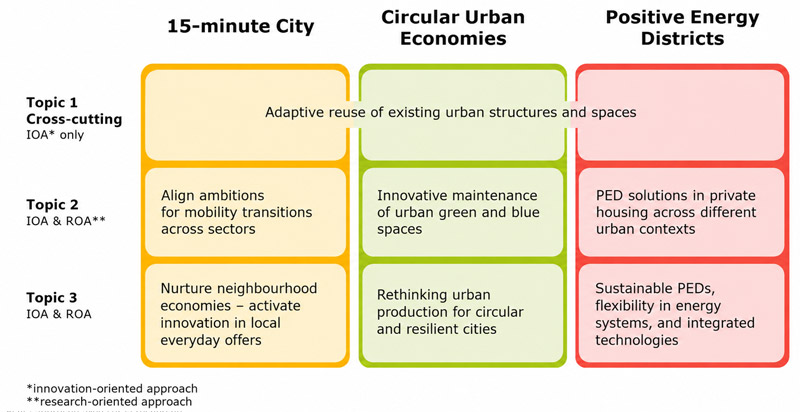
This year, the DUT 2026 call for proposals features a cross-cutting theme that is relevant to all three thematic areas. The aim of this cross-cutting theme is to support innovation-focused projects. This topic is only open for applications making use of the Innovation Oriented Approach (IOA). This topic has a specific transnational eligibility criterion to include at least one private sector organisation
Adaptive reuse transforms existing buildings and urban spaces into new uses, reducing resource consumption, limiting urban sprawl, and supporting sustainable, people-centred cities. To unlock its full potential, projects must overcome regulatory and governance barriers while ensuring socially inclusive, systemic, and place-based urban transformation.
Positive Energy District (PED): PEDs are based on optimising energy efficiency and energy production from local renewable sources, as well as energy flexibility. They will be connected to national and European energy systems. The integrated approach encompasses technological, spatial, regulatory, legal, financial, environmental, social and economic perspectives.
15-Minute City (15mC): The 15mC project aims to establish integrated, mixed-use neighbourhoods, which are essential for reducing greenhouse gas emissions in the transport and logistics sector. The 15mC takes into account the diversity of contemporary lifestyles, including digital aspects, and aims to promote climate-neutral, liveable and inclusive cities. The objective is to facilitate the analysis, development, experimentation and testing of innovations in co-creation contexts.
Circular Urban Economies (CUE): This pillar supports the planning and design of inclusive urban spaces based on circular resource flows. Circularity should be viewed as a means to an end, rather than an end in itself, and as a tool for achieving sustainable urban transitions. To this end, it encourages the development of a wide range of tools and approaches that combine efforts to increase urban resource efficiency and liveability, thereby addressing a number of challenges. This involves examining the effectiveness of digital tools in facilitating the sharing of urban resources and circularity without excluding any social group, as well as the balance between incentives and disincentives, and the fair design and implementation of resource-sharing and circularity measures.
The ANR covers all three thematic areas, but only Topic 2 and Topic 3. The ANR does not fund projects submitted under the cross-cutting Topic 1.
Useful information
Further information on this Call (mandatory templates to use for applying, link to the submission platform…) can be found on the following website
https://dutpartnership.eu/calls/dut-call-2026
The funded projects within this Joint Call must be submitted by a consortium consisting of at least three eligible Applicants from at least three different participating countries. In addition, at least two of the eligible Applicants must be from different EU Member States or Associated Countries eligible for EC co-funding in this Call.
Consortia must include at least one urban government authority (city, municipality or entity providing key urban services) either as a Main Applicant, Co-applicant, or Co-operation Partner depending on the national/regional eligibility criteria.
All funded partners in this Call will be funded by their national Funding Agencies in accordance with their respective national/regional eligibility criteria.
ANR will only fund French teams. French partners requesting funding from the ANR are invited to read the document "Modalités pour les participants français", available on this page.
Contacts:
All along the process, the call secretariat is the point of contact for any applicant: call(at)dutpartnership.eu
ANR national contact points :
Amina Ghorbel
National Research Agency
amina.ghorbel(at)anr.fr
Wassim Sebai
Agence Nationale de la Recherche
wassim.sebai(at)anr.fr
Pascal Bain
National Research Agency
pascal.bain(at)anr.fr
Consult the upcoming and current calls of the appelsprojetsrecherche.fr portal

The appelsprojetsrecherche.fr portal centralises all information on calls for proposals and calls for applications from ADEME, ANR, Inserm including ANRS, Anses and INCa. It provides a simplified access to upcoming and ongoing calls, giving a greater visibility to funding opportunities. Following their closing date, the calls remain published for a few months.
Portail appelsprojetsrecherche.fr
