

A collective effort to combat antibiotic resistance
What characteristics and challenges are connected to antimicrobial resistance?
Marie-Cécile Ploy: Bacteria can adapt and acquire mechanisms to defend against antibiotics. They develop resistance to the drugs designed to combat them, making infections more difficult to treat. This is known as antimicrobial resistance (AMR). If we take antimicrobials in the broad sense, this also includes the mushrooms that defend themselves against antifungals, parasites that defend against antiparasitics, and viruses against antivirals.
Today it is estimated that AMR directly causes 1.3 million deaths each year, with projections on the order of 39 million deaths by 2050 if nothing is done. With regard to livestock farming, antibiotic resistance generates an economic loss of 13 billion dollars per year, and the environment is affected by the emission of antibiotic and biocide residue. Bacteria circulate everywhere in all ecosystems!
Can you give examples of research fields that study AMR?
M.-C. P. : Research is conducted in three primary focus areas: preventing, containing, and reducing antibiotic resistance.
The research fields are numerous and varied. They involve better understanding the mechanisms by which resistance emerges, and developing new diagnostic, therapeutic, and preventive solutions. The transmission, prevention, and control of infections are also studied, as is the proper use of antibiotics. The social, economic, and cultural factors surrounding antibiotic use must also be taken into account.
How are the projects funded by the ANR that you coordinated in keeping with a One Health approach?
M.-C. P. : The goal of the first project, DynamINT, which was launched in 2012, was to better understand how integrons function, with a view to identifying new avenues for combatting multi-drug resistance in bacteria. Integrons are an effective genetic tool that enable bacteria to adapt to environmental stress, and we demonstrated the existence of a system of induction, which is to say a system that is triggered under the effect of antibiotics, and enables genes to acquire new resistance. Our work began in vitro, and then developed in vivo models, notably a biofilm, a form of bacterial life that is found, among other places, in the digestive system and sewage pipes. This intention to confirm our results in “real life” was a first step toward a One Health approach.
The second project, PRE-EMPT, began in late 2020. Via these two projects, a One Health approach took root in our practices, with a patient-animal-environment continuum, and the transition from in vitro to in vivo. PRE-EMPT is a perfect illustration of this dynamic, as we set out from the environment to identify new antibiotic resistance genes, and to better understand genetic diversity in all ecosystems. We began with samples taken from environments with different degrees of anthropisation2, starting with protected areas located in Arcachon Bay, and moving to highly anthropized zones, such as hospital wastewater. The project helped overcome technological obstacles thanks to innovative gene capture techniques and bioinformatic analyses, and identified hundreds of new potential resistance genes, which will soon be the subject of a scientific publication.
How did the PROMISE professional community network, funded as part of the Antibiotic Resistance Priority Research Programme (PPR, France 2030), help structure research in France?
M.-C. P. : During preparations for the Antibiotics Resistance PPR, the Scientific Board identified the structural tools for making research more competitive that are lacking in France. This led to funding for multiple projects, including the PROMISE professional community network.
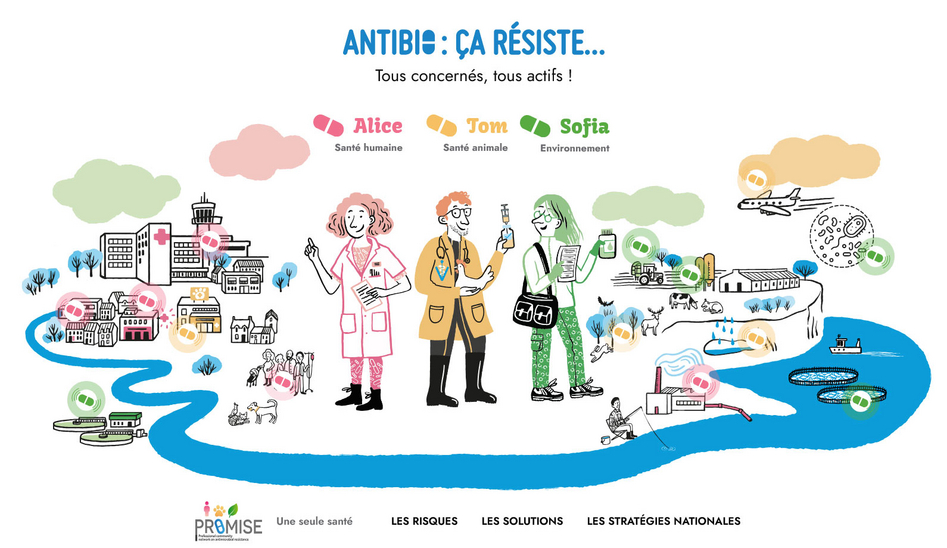
The latter, which I coordinate with Dr Bruno François, includes 120 member-partners. It fosters knowledge and expertise sharing, and promotes exchange between actors in human health, animal health, and the environment, who usually work in isolation. This allowed us, among other things, to develop a data platform to monitor AMR in France from a One Health perspective. Collaboration within the professional community network also made it possible to establish networks that did not exist before: a preclinical research network, AntibioDEAL, and a research network for monitoring resistance in the environment, AMR-Env. The professional community network also plans awareness-raising activities targeting the general public. In late 2025, the interactive website named “Antibio, ça résiste… Tous concernés, tous actifs !” (Antibiotics, it resists…All concerned, all must act!)3 was made available online, and a comic book is currently being prepared.
Why is international collaboration important in antibiotic resistance?
M.-C. P. : Strengthening international collaboration, and more specifically interactions between public policy and research, is essential, and can be based on initiatives and networks that already exist on the national or regional level.
With respect to research and innovation, international funding programmes play a major role, such as the JPIAMR programme, and the OHAMR (One Health Antimicrobial Resistance) European partnership, both supported by the ANR.4
With respect to public health, we can cite the example of the European Joint Action on Antimicrobial Resistance (EU-JAMRAI), which France leads via Inserm, and which I coordinate. It brings together 30 European countries and over 120 partners to make Europe a model for best practices. Different aspects of antibiotic resistance are explored, including access to antibiotics, prevention, hygiene, use, and monitoring, while a network of public decision makers was created for the implementation in each country of appropriate measures, growing out of actions led by EU-JAMRAI.
Awareness efforts were also implemented, notably the creation of a logo – a symbol of antibiotic resistance distributed throughout the world – and diffusion of the Sketching Antimicrobial Resistance campaign, which led to a book and a travelling exhibition to raise awareness among Europeans regarding the importance of preserving antimicrobial effectiveness, for “taking care of antibiotics is taking care of all our lives.”5
More informations
PROMISE Professional community network
Supported in connection with the Antibiotic Resistance Priority Research Programme (PPR), led by Inserm, and operated by the ANR on behalf of the French government as part of France 2030
PRE-EMPT Project
Supported in connection with the ANR’s 2020 Generic Call for Proposals
Partnership
- RESINFIT – Antimicrobials: Molecular Supports of Resistance and Therapeutic Innovations (Inserm, Université de Limoges, CHU de Limoges)
- ANSES – Antimicrobial resistance and Bacterial Virulence Unit of the Lyon Laboratory
- ISP – Infectious Diseases and Public Health (INRAE, Université de Tours)
- Institut Pasteur
https://anr.fr/Project-ANR-20-CE35-0011
DynamINT Project
Supported in connection with the ANR’s 2012 Blanc programme
Partnership
- Inserm
- Institut Pasteur - Bacterial Genome Plasticity Unit
- Université Paris Sud - Microbial Digestive Ecosystem and Health
1 Source : Ploy M.-C. et Madec J.-Y. (2025) L’Antibiorésistance, un défi global, des actions communes, Med Sci (Paris), 41(11). https://doi.org/10.1051/medsci/2025188
2 Transformation of natural environments by human activity
3 https://www.antibioresistance-une-seule-sante.fr/
4 Marie-Cécile Ploy served as the Vice President of the JPIAMR International Research Programme, and is a member of the Strategic Committee of the OHAMR European partnership.
5 https://eu-jamrai.eu/raise-awareness/campaigns/sketching-antimicrobial-resistance/
Caption: Interactive website www.antibioresistance-une-seule-sante.fr, created in connection with the PROMISE project.
